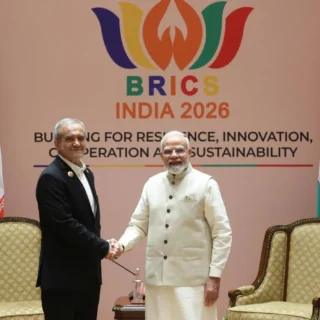
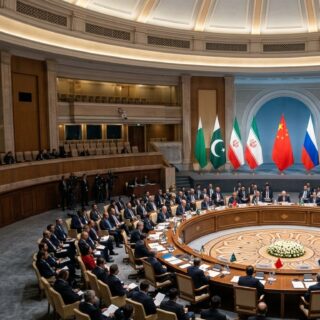
The diplomatic calendar counts meetings; measuring their success requires examining the world they leave behind. September 2026 offered several scenes of international cooperation, from Bishkek to New York.
On September 1, the Shanghai Cooperation Organization’s summit approved 28 documents. From September 22 to 28, the United Nations General Assembly held its general debate. On September 26, the Economic Cooperation Organization convened an informal ministerial meeting on its sidelines.
Read together, these gatherings raise an important question: if states are in constant contact, why is it so difficult to turn shared decisions into tangible results?
One clue lies in the organizations’ membership. Six of the Economic Cooperation Organization’s ten members—Iran, Kazakhstan, Kyrgyzstan, Pakistan, Tajikistan and Uzbekistan—also belong to the Shanghai Cooperation Organization.
Comparing the two lists shows why regional politics cannot adequately be understood as a collection of separate alliances. Many states participate in several institutions simultaneously, seeking different benefits from each. Shared membership creates opportunities to meet; common priorities, financing and workable agreements require additional effort. This distinction is central to understanding September’s crowded diplomatic calendar.
Iran illustrates this pattern of diplomacy. In New York, its priority was negotiation with the United States through mediators, seeking a way beyond the impasse over the war and the Strait of Hormuz. In Bishkek, it participated in the SCO’s regional political and security consultations.
Its ECO membership, meanwhile, connects it to opportunities for trade and transport with neighboring countries. Reuters reported separate contacts between American and Iranian officials and mediators in the final week of September.
The example shows how global, regional and economic forums serve different needs for the same state. Continuing negotiations at one table does not mean disagreements have disappeared at another.
The same distinction emerged on a global scale at the UN. In his address, Secretary-General António Guterres described two possible paths towards a multipolar world: a system shaped by fragmentation and transactional deals, or an interconnected world governed by shared rules.
Associated Press coverage highlighted demands for fairer representation and dissatisfaction with the distribution of power in the Security Council. Reuters’ assessment, meanwhile, pointed to limited decisive progress on major conflicts despite the diplomatic activity. The General Assembly’s value lies in its breadth of representation, its capacity to generate political pressure and its role in shaping global priorities.
Yet a speech in the general debate, an adopted resolution and its implementation are three distinct stages. Treating activity at the first stage as success at the third misreads both the institution’s capabilities and its limits.
The 28 documents approved in Bishkek included the summit declaration, a protocol amending the organization’s charter and decisions covering several areas of cooperation. One telling feature was the “SCO Plus” meeting’s focus on the UN’s central importance to a just world order. This complicates the assumption that expanding regional organizations necessarily seek to replace global institutions.
Here was a regional forum strengthening its own position while affirming the UN’s importance. But moving from political agreement to economic capacity requires resources: the proposed SCO Development Bank did not become an operational lending institution as a result of the Bishkek summit.
Assessing the organization’s economic progress therefore requires scrutiny of financing arrangements, responsible institutions and implementation milestones, alongside the documents adopted.
The figures presented at the ECO meeting connect this debate to economic realities. Addressing the organization on September 26, 2026, Ishaq Dar said that the region, home to roughly half a billion people, accounted for around 2.2% of global trade, while trade among its members represented approximately 8% of its total trade.
The 8% figure does not, by itself, establish all the reasons for limited trade, nor does it show that membership in the organization has no value. It does, however, raise a serious question: what is missing from the effort to turn the region’s economic potential into trade among its members?
The answer must be sought beyond announcements of new corridors—in border procedures, transport costs, payment arrangements and reliable access to trade routes.
Pakistan: A Practical Test of Shared Membership
Pakistan provides a practical example. For 2026–27, it chairs the SCO’s Council of Heads of State and the ECO’s Council of Ministers. SCO national coordinators met in Islamabad in late September, where an Indian representative’s participation demonstrated the scope for continued institutional engagement despite political disagreements.
Meanwhile, the ECO’s priorities include corridors linking Central Asia to the Arabian Sea. A framework agreement for a joint feasibility study of the Uzbekistan–Afghanistan–Pakistan railway was concluded in July 2025. The practical challenge is clear: security concerns involving Afghanistan must be addressed alongside the need for trade routes passing through its territory.
The two chairmanships offer an opportunity to advance the agenda; their success will depend on translating that opportunity into workable cooperation.
Judging all three institutions by a single measure would also be misleading. The General Assembly’s value cannot be measured solely through trade figures, just as an economic organization’s success cannot be established simply by issuing a political declaration.
Each institution should face questions appropriate to its authority and purpose. Have diplomatic contacts produced an actionable agreement? Have resources and responsibilities been assigned to regional decisions? Has economic cooperation removed an obstacle to cross-border trade?
Progress towards the ECO ministerial meeting expected in November and the SCO summit in 2027 can be assessed against these questions. A change in the share of intraregional trade will be a longer-term indicator; the immediate test concerns the steps that make such a change possible.
September’s diplomacy reveals a world in which representation, regional influence and economic cooperation are distributed across different institutions. Six shared members show that human and governmental connections between these organizations already exist. The ECO region’s approximately 8% share of intraregional trade is a reminder that contact does not amount to completed economic integration.
The next test of power is whether states can translate their overlapping memberships into decisions backed by resources and clear responsibility for implementation.
When the next diplomatic calendar opens, will the connections between these tables be visible in easier cross-border trade and more reliable cooperation—or will readers once again be told how many meetings took place?